What do you need to know while procuring an Expert System AI.
Working with text and speech semantics is now also the job of an IT engineer. Because we’ve entered the realm of intelligent technologies. And now engineering methods are available for working with speech and human cognitive operations.
25 Jul 2026 6 minutes read updated on: 26 Jul 2026

Deutsche Version der Publikation.
Русская версия этой публикации.
It's also obvious that such work with workflows "exposes" them more thoroughly than any job description ever could. What drives optimizations for processes is brought to discussion and scrutiny, always. Sometimes even official documents are developed describing processes and data that previously existed only in the minds of personnel.
It’s not a big secret that all enterprises have an idea of a “desirable” and “undesirable” client. For software developers with innovative components, there's also a special concept: the "best possible client." We defined this based on the fact that our industry is complex to understand. That’s why we committed ourselves to providing clear explanations for everything, and most importantly, ensuring those explanations are meaningfully linked to the real problems of customers and users. Only then will management and control over their software truly be accessible to the owner in their own terms, and the issue of shared responsibility for the outcome will be resolved automatically: it becomes clear how specific decisions were made and how they will impact the business, and what their “cost” is in all senses of the word.
One such "best" client stepped into the process of creating an Expert System AI for their business. They were very interested not only in automating routine tasks but also in transferring the decision-making process itself to the computer at an expert level, because it offers numerous advantages and frees up time for their experts in educational solutions to work on developing new approaches in atypical situations.
We sent the client a description of the Expert System AI creation process. We tried to describe our team’s interaction with the client's subject matter experts in detail and using the simplest language possible.
What is actually this other strong AI type - Expert Systems?
Engineers have not only technologies and tools for programming, but also a complete set of technologies and tools to make complex cognitive processes within an expert’s mind explicit when they are making a decision on their topic. It is exactly this work with speech and thought using strong AI tools that allows us to accurately transfer the cognitive processes in a person's head to the machine. It looks like magic if the machine does the same thing, and without the "hallucinations" we’re currently seeing from neural networks. A human expert makes their decisions not only based on reasoning but also instantly gathers all important situational contexts into a single, well-considered solution. But breaking down this cognitive process into every small detail and assembling it using machine logic and a hierarchy of often contradictory inputs requires a lot of work. That’s what we described to show the client how it works. And it works accurately, without errors, and there is always readiness for changes from the human expert if something changes in the solution itself or in current circumstances.
You know that our motto isn't just to present the business implications of technical solutions but also to demystify IT. So we were surprised when our best client said they were "not ready" to do what we described because of... a lack of their own qualifications!
This was our epic failure! And our client essentially reaffirmed their “qualification” as a best client. Before undertaking software development, they wanted to clearly understand exactly what would be required of them during the process.
Taking a deep breath, we realized where the misunderstanding had occurred. Everyone these days is accustomed to developers talking about databases, memory, file systems, UX, etc., and many software customers are quite familiar with industry terms. But no one yet expects that speech, thinking, and decision-making are also things an engineer works on finding patterns, building a path of operations with concepts, the logic of reasoning, a model of “understanding” the situation. Our client automatically assigned these tasks to their area of responsibility. They thought they and their employees would have to do all this work themselves and present us with the results, which we would then program.
We've entered a new technological AI reality, but our assumptions haven’t yet adjusted. However, as before, nothing is required from human experts that exceeds their own knowledge and education. All methods of researching cognitive processes are in the hands of IT engineers. Indeed, programming languages are also... languages. With their own built-in rules and contexts. Human languages can be worked with similarly. But the most important thing is to ensure that the linguistic content not only becomes understandable but is also placed into reliable engineering solutions for working with it.
What dataset does one need when developing an Expert System AI?
Everyone seeking to implement AI within their enterprise has encountered the challenge of requiring massive historical datasets spanning long periods for AI training.
The good news is that the development of Expert Systems, which are based on Strong AI approaches and utilize language models in a supporting role, does not require large volumes of data.
The only data required are current data, which are collected during the development process of the Expert System (ES). This collection process follows principles that differ from those of standard AI training, as the priority is placed on the contextual meaning surrounding the data to solve the specific tasks of the given Expert System.
The purpose of data collection for an ES is to cover the most frequent scenarios that require expert decision-making. During the testing phase, only a small dataset will still be required for further refinements, should they be necessary.
There is no need to collect and store data for a decade. Furthermore, the existing principles of data organization often prove to be a hurdle when addressing specific questions within real-world processes.
It is also important to note that ensuring the security of sensitive data within large datasets demands significant effort and resources. In contrast, data used to create Expert Systems can be easily anonymized.
How should data be collected for an Expert System AI to work?
ES developers first determine the data requirements during the needs assessment phase and the creation of the ES semantic prototype. Typically, not in the ES-case, data is organized in a way that is most advantageous from a systemic perspective for machine processing. Furthermore, the selection of accompanying information (metadata) is often merely formal and not justified by real-world processes.
When creating an ES, data collection and access are organized by developers along the conceptual lines of how personnel actually work with the data. This is why the concept of data requirements and their organization for use in live processes will be intuitive and convenient for all staff. Consequently, data collection will be easy and effortless.
Will implementing an Expert System AI harm the expert’s workplace?
How do you choose which decisions to delegate to the Expert System AI?
How much time will the customer's expert personnel spend transferring their cognitive processes to the developers of the Expert System AI?
-

Are these technologies accessible to small and medium-sized enterprises?
26 Aug 2026 4 minutes read
-
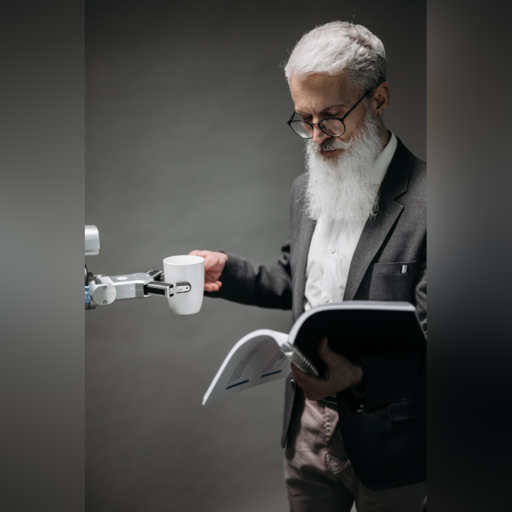
Working with text and speech semantics is now also the job of an IT engineer.
25 Jul 2026 6 minutes read
-

Why is a single "IT expert" no longer enough in the office today, as it was the case in the past?
07 Apr 2025 4 minutes read
-

Who will be able to solve your new and old business challenges?
03 Mar 2025 2 minutes read
-

Directions of digitalization where innovative solutions can be applied.
27 Apr 2024 7 minutes read